

Our team is celebrating planting 40,000 mangroves.
You read that right – 40,000!
In February 2026, more than 50 workers spent 10 days at the mouth of the Baraderes River, which stretches about 30 miles along Haiti’s southwest peninsula and through the remote coastal region of Baraderes. Known for its rich greenery and biodiversity, the area has been increasingly threatened by exploitation of local wood resources and increasingly devastating storms that are steadily eroding its shoreline.
Over those ten days, CORE hired local community members to plant four species of mangroves. Workers waded through the shallow, murky water, passing sprouts one-by-one, fire line style, from the water to the shore. The result is a thriving new mangrove nursery and a milestone well worth celebration. But that’s not the full picture – there’s so much more to this win for Haitian communities. Let’s dig deeper…
What's a mangrove?
A mangrove is a tree or shrub that lives right where the land meets the sea. They’re built to handle salty water, shifting tides, and muddy ground; some even grow their roots underwater. Think of them as nature’s coastline warriors, defending the shores while thriving in conditions most plants couldn’t survive.
We care a lot about mangroves. Here's why:
- Healthy mangroves buffer coastlines in the face of storms, protecting against erosion and flooding. This is increasingly critical, especially as countries like Haiti face more frequent and more powerful storms, like Hurricane Melissa that flooded multiple communities in October 2025. Experts estimate that worldwide, mangroves provide flood protection for over 15 million people per year.
- Mangroves provide natural habitat for thousands of fish species, including economically important ones. For local fishing communities, that means more opportunities to earn money and put food on the table.
- Mangroves store up to four times more carbon than tropical forests. If left undisturbed, they can lock away the climate-warming greenhouse gas for millions of years.
What does a mangrove have to do with CORE?
Since 2023, with support from our partner Caribbean Biodiversity Fund, we’ve been working on the ecosystem-based adaptation, or EBA, initiative. At its most basic level, this years-long effort is focused on investing in resources, tools, and hands-on education and training that make Haitian communities more capable of adapting to the increasing threats of climate change and countrywide instability (think severe and frequent storms, food insecurity, and a general lack of economic opportunity).
“This work represents a lot for us. I am not only speaking about us in Baraderes. It is part of the whole world.”
Max Saby, program participant
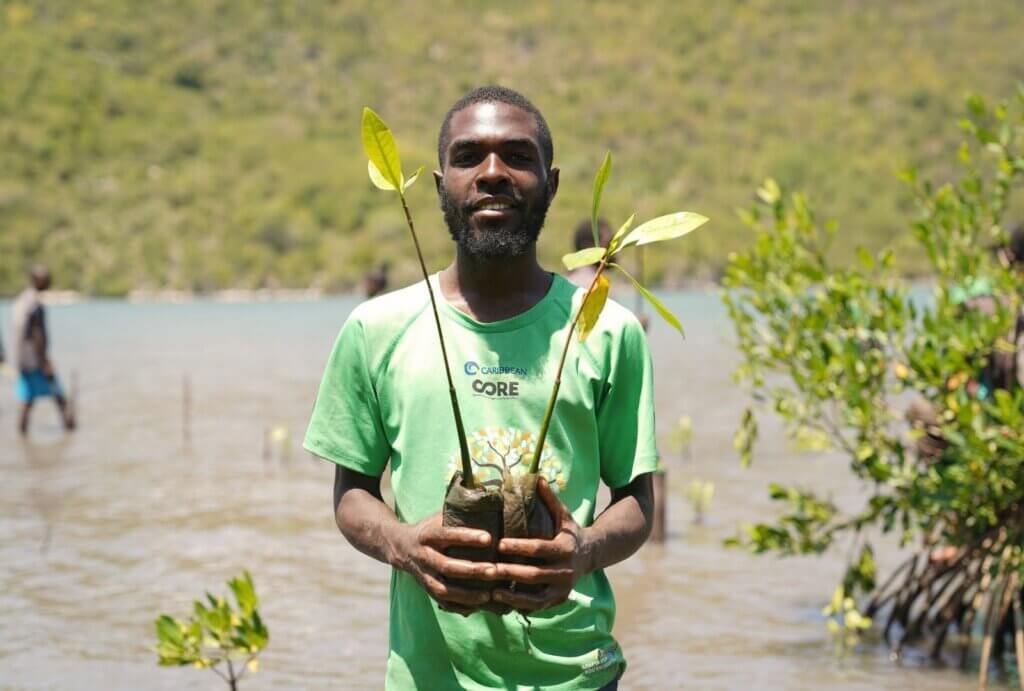
Our local team, based in Les Cayes, travels to reach communities across Haiti’s southern region—Les Cayes, Baraderes, Petite Goave, and more—places that are considered particularly vulnerable and where farming and fishing are the primary means of earning money and feeding your family. Activities range from organizing students in school environmental clubs, training farmers in sustainable agricultural practices, beekeeping, lessons in cacao harvesting and production, and, of course, planting mangroves – lots of them.
The resilience of Haitians is undeniable – time and again, they’ve stepped up for one another when others won’t. CORE, however, has been there through it all. In our 16 years of working in Haiti, our teams have seen and experienced firsthand the devastation caused by natural disasters: emergency boat evacuations, flooded homes and muddy unpaved roads, total loss of crops and farmland. Investing in climate adaptation programs is a no brainer. To learn more about CORE’s time in Haiti, click here.