Hands-on Cocoa Skills Training Opens New Doors for Haitian Women
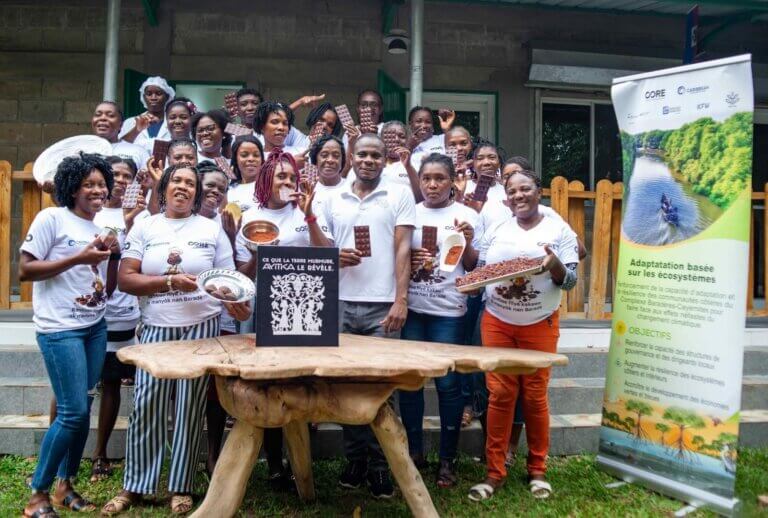
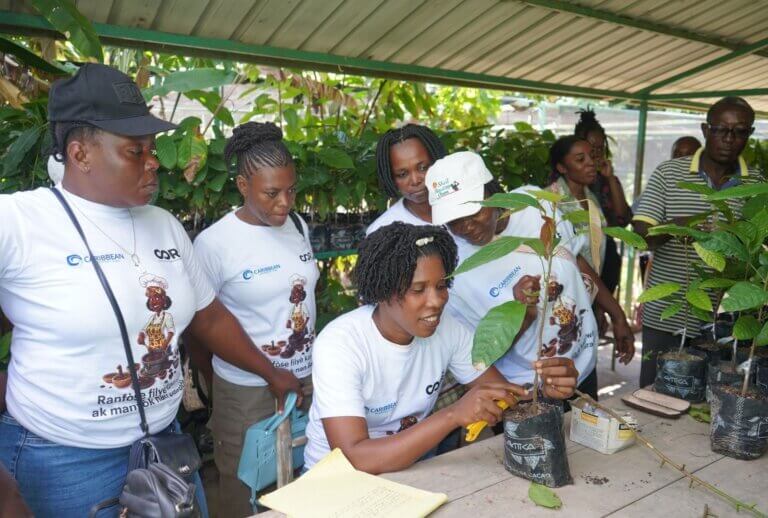
In early 2026, CORE organized a three-day training in Camp-Perrin that brought together twenty women from four local women’s associations. In partnership with Ayitika, one of Haiti’s leading cocoa producers, the sessions were designed to equip women with hands-on skills in cocoa production and processing, a livelihood that has long supported Haitian small farmers.
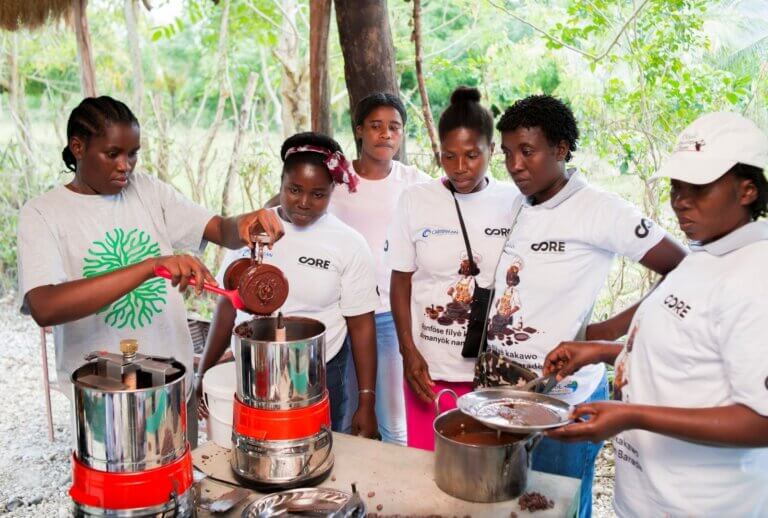
While many were already familiar with traditional methods of producing cocoa at home, they lacked the equipment and materials to move up the value chain. So, our approach was simple and hands on from the get-go, and the women spent most of their time learning by doing. They immediately dove into practical techniques to boost cacao quality and yield of cocoa, while also learning to use tools that make their work faster and more efficient.
RELATED | CORE PROVIDING LONG-TERM FARMING SUCCESS IN HAITI
One of the key activities was cacao grafting, a technique that allows farmers to strengthen and improve their trees. By taking a cutting from a healthy, high-performing tree and carefully attaching it to a younger one, the women saw firsthand how they could cultivate stronger plants and achieve more reliable harvests.
“This training is very important for us as women from different organizations because we are already working in the cocoa sector. We will be able to do more and increase our income. We will continue to work to improve our profits in the cocoa value chain,” shared Serette, a member of REFATAB (Rezo Fanm Taren Baradères), a women’s group in Baradères.
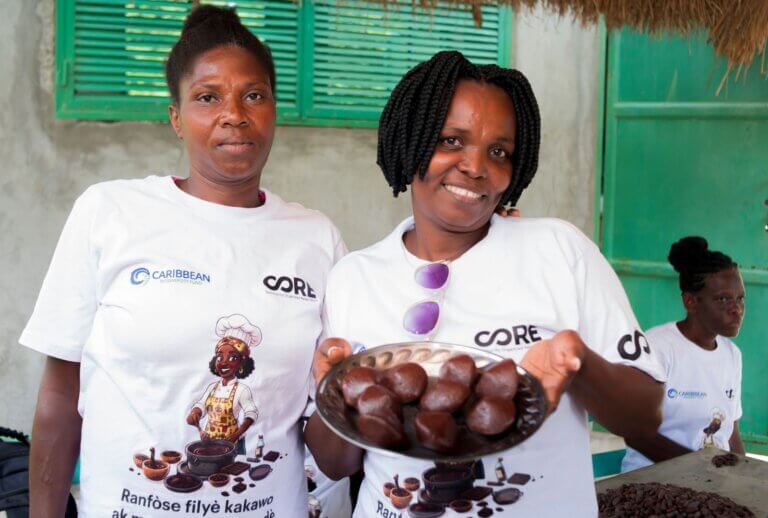
But the training didn’t stop in the fields. The group also explored what happens after the harvest, transforming raw cacao into value-added products like chocolate balls, chocolate tablets, and cocoa butter. These new skills open doors to increased income and local entrepreneurship. By the end of the three days, the women walked away with practical experience and a clear vision for what’s possible. Now, CORE is working to purchase the equipment needed for these local leaders to take this training back home to their communities.
Reflecting on the three-day training, Telisma, a leader of a women’s association called FDF, or Fanm Devwe de Fond Tortue, said, “We are going to come together, those of us who received the training, and we will share what we have learned. We will practice with others who did not attend.”
This cocoa skills training is part of CORE and the Caribbean Biodiversity Fund’s years-long ecosystem-based adaptation (or EBA) initiative, which is focused on equipping communities with the knowledge and resources needed to adapt to the rapidly evolving climate reality. In action, this includes activities like planting mangroves along the coast, teaching students to become leaders through environmental clubs at school, and introducing small farmers and fishers to sustainable agricultural techniques that help them provide for their families.
RELATED | SEE CORE’S MANGROVE RESTORATION AND ENVIRONMENTAL EDUCATION IN ACTION
Telisma’s words capture the heart and common purpose of each EBA activity: sharing knowledge in a way that keeps growing. At CORE, we know that investing in even just one farmer, fisher, mother, or student goes a long way. When community leaders have the tools to use these skills themselves, they teach and support others in doing the same. In this way, knowledge spreads, livelihoods strengthen, and the impact of each activity reaches far beyond those initial moments – and that is what real community empowerment looks like.
Visit the Haiti page to learn more about CORE’s ongoing work in Haiti.