


CORE’s Disaster Case Management Program at Work in Altadena
It’s been almost two years since the Eaton Fire destroyed much of Altadena. Many who weren’t impacted have moved on, giving the disaster little more than a second thought as they turn their attention to a laundry list of other disasters or tragedies across the globe. Maybe some have thought that, now two years on, things have returned to normal in Altadena. That’s far from true.
We’re going to throw out a quick statistic that is hard to wrap one’s mind around. Over 70% of people who lost their homes still aren’t back. Drive around Altadena, and you’ll see lot after lot sitting empty.
Recovery is hard, and the path back is often anything but clear. At CORE, we recognize this unfortunate reality: recovery, on average, takes years, not weeks or months.
To help those on the long journey back home, CORE has a Disaster Case Management Program (DCMP) based out of The Hub, our long-term recovery center in Altadena. To date, our dedicated team of case managers has assisted nearly a thousand families on their recovery journey, with hundreds still with active cases, and even more on a wait list.
Read below to learn about some families this program has helped on their recovery journey.
Meet Mary
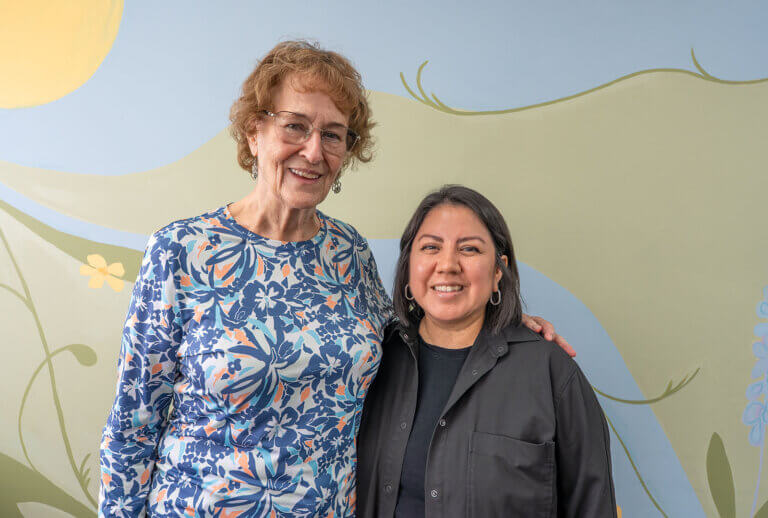
Mary has lived in Altadena for close to 50 years and has loved nearly every minute of it. Her passion for her community is infectious. It only takes a few minutes of talking with Mary to learn some new, interesting fact about Altadena and its remarkable history. She spent decades in education, is a member of a local historical society, and has been a part of the Christmas Tree Lane Association.
If you go into Altadena Community Center today, you’ll see an historical exhibit Mary helped to curate. It’s a spectacular cross-section of a tree that grew on Christmas Tree Lane, showing important events in Altadena over the past 140 years, going ring by ring. Mary, to say the least, knows her stuff about the community she chose to call home.
Unfortunately, like so many who called Altadena home, the Eaton Fire changed everything.
On the night of the fire, Mary knew almost immediately she had to get out. She’d taken the CERT (Community Emergency Response Team) classes and heard about the dangers of a wind-driven wildfire in the wildland-urban interface, like Altadena. So, that night she quickly packed a few important things and left.
She evacuated to a local shelter, kept an eye on the news, and waited to hear anything about what had happened to her home. Then came the call the next day. Her son told her that he’d heard their home, and nearly every other home on the block, had burned down. She was devastated; she’d built her life here, and now the entire neighborhood was gone.
Mary, though, was determined to remain in Altadena. She found temporary housing and now lives a few towns over, but wants to rebuild on the same lot she called home for decades. But, as with so many things, getting back home wasn’t so cut-and-dried. Mary discovered all of the hurdles one has to jump through, both financial and administrative, to rebuild.
Mary readily admits that technology isn’t her strong suit. So, when it came to visiting websites and filling out online forms, she felt lost.
Luckily, Mary got in touch with CORE. Shortly after connecting with us, she began working with Veda, her case manager. As a case manager, it became Veda’s responsibility to guide Mary through the rebuilding process, which included helping Mary fill out those confusing forms and navigate online to find resources.
According to Mary, Veda has been nothing but wonderful, offering a true lifeline in such an uncertain time. Most importantly, though, Veda has provided Mary with a much-needed sense of hope.
“I think without CORE, I would probably have given up. But I have a great person to work with here, and her name is Veda. She is so wonderful, and she’s helped me establish a way to help me financially. And she’s opened my eyes to different things that are available,” Mary said. “And I don’t think I would have known about any of them without her. It’s really important for people like me who felt so low and sad and like I lacked the ability. But because CORE was here, it helped me greatly.”
Now, with Veda’s guidance, Mary is on the cusp of breaking ground on rebuilding her home, which will be made of shotcrete, a material known for being strong and fire-resistant. It’s been a long journey, much longer than Mary could have imagined, but there’s now light at the end of the tunnel.
Meet Jose & Ubeet
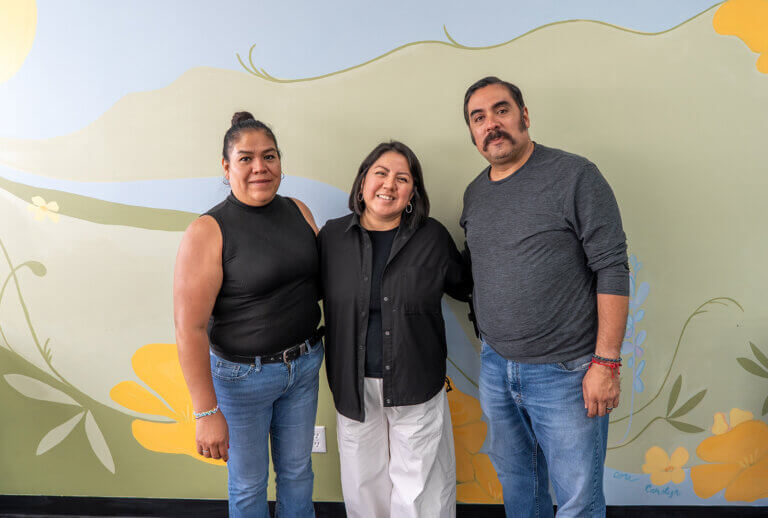
Jose and Ubeet moved to Altadena over a decade ago. They loved it there, from the atmosphere to the people, and the view of the San Gabriel Mountains; it was perfect. They’d built a good life, him as a mobile mechanic, her as a housekeeper. But then the fire came and changed everything.
The fire moved quickly. They could both see it from their apartment complex. Everything around their building burned. Some might call them lucky; their building didn’t burn to the ground. But even as the building remained standing, they weren’t unscathed.
Jose’s truck, the one with all of his mechanic’s tools, the one he used to work, burned down. Then, because of the smoke damage, they had to get rid of everything in their apartment. That included their furniture, their clothes, and everything in between. While they might be lucky to still have a place to stay, once it was safe after smoke remediation, they had to start completely over.
How do you even begin to start over? If you’re in your home right now, take a moment to look around at all of your stuff. Your couch, the throw pillows, the bookshelf, your dining table, your chairs- all of it, large items to small ones- it’s a lot. Most of us didn’t buy these things all at once. We acquired them over years, when our paychecks gave us a little flexibility to build our lives.
For the couple, starting over put them in a nearly impossible spot. Without his tools, Jose had no way to get back to work. He and Ubeet made their way around town, visiting community centers and resource fairs to find help. Then, one day, they discovered a CORE booth and connected with our team.
From there, they were connected with Veda, who now serves as their case manager. Veda has helped them fill out paperwork and has kept an ear to the ground to let the couple know what resources are out there for them or if there are any new opportunities.
With Veda’s help and guidance, Jose was awarded some money to help him buy some new tools. It didn’t replace everything he’d built up over the years, but it’s a way for him to get back to work and a meaningful step forward, even as times remain tough.
That reality is a bit easier because they know they have Veda in their corner, which has meant a lot.
“There are no words to explain. She has been so helpful. She’s just a nice person and a good person,” Jose said.
Jose has even talked to his neighbors, some of whom are struggling with the same things that they are, and told them about what CORE has meant to them and what CORE has been able to provide. He wants people to know how helpful the team is and how friendly they’ve always been when he and Ubeet come to the Hub.
The work continues. Two years on, there is still so much need, and Jose and Ubeet are not back to where they were before the Eaton Fire, but they’re moving in the right direction.
How You Can Help
This Disaster Case Management program matters. It’s clear when you talk to any of our DCM clients or their case managers. So much good work is being done each and every day. It might not always be flashy, and things might not take big leaps, but it still matters. A win is a win no matter how small, and when the recovery wins add up, that’s when we see families returning home. Without this work, so many of our clients, like Mary, Jose, and Ubeet, would be worse off today.
RELATED | Read More Disaster Case Management Stories
If you would like to continue supporting our Disaster Case Management Program, please consider donating. It means the world to us and to those we have the privilege of assisting each day. If you’re unable to donate at this time (we get it, times are hard), please share this story with your friends and families. To stay informed on CORE’s work, follow along on social media.
Hear From François
“We received training on how to enter the apiary, how to harvest, and how to work with the bees. Yes, it provides an additional source of income; as you can see, we are now working in the apiary,” said François.
“Not only did we receive training in modern beekeeping techniques, but we are also no longer struggling.”