

Flooding in Hawaii: Homestead Rebuilding
In March, Hawaii faced some of the worst flooding conditions it’s seen in decades. You might have seen the headlines. On O’ahu, torrential rains blocked roads, flooded homes, and officials sent out dire warnings of a potential dam collapse that would have destroyed entire neighborhoods. Luckily, that worst-case scenario didn’t come to pass. But the impact was real.
Floodwater had torn through neighborhoods, leaving some homes damaged or destroyed and thick layers of mud and debris everywhere.
Our teams quickly deployed to the island’s north shore to help communities clean up by providing critical supplies and training to give them a head start in their recovery. The training gave community members the tools and expertise to begin mucking and gutting, the crucial first step in repairing water-damaged homes and getting families back home. With this knowledge, these community members and leaders could return to their neighborhoods and get the work done.
What is Mucking & Gutting?
Learn all about mucking and gutting and why it’s the first big step to recovery.
On O’ahu, we also met with Erika, a local farmer, whose family had operated the farm for generations. Our teams brought out heavy equipment to help clear debris before it could further disrupt and contaminate the soil, ensuring that future harvests would not suffer.
It was at this farm, and through Erika, that we started to hear about the damage people were seeing on the nearby island of Moloka’i.
The Forgotten Toll
What many didn’t see in headlines was that Moloka‘i had faced similar levels of severe flooding as on O’ahu and experienced heavy damage. So, our teams began our immediate outreach to see how we could help.
One of the first things anyone notices the first time they visit Moloka‘i is the beauty; the second is how it’s unlike nearly anywhere else in Hawaii. When driving around the island, you won’t see any mega resorts, big-box stores, or even a stoplight.
As a trade-off for this lack of overdevelopment, the island is also fairly isolated. With no big-box stores, things are often expensive. Residents also rely on container ships that come to drop off food and supplies. So, when those ships can’t come, as in the case of these storms, residents have to rely on what they have on hand.
For the 7,400 people who call the island home, it’s a unique way of life, full of a tight-knit sense of community and a fiercely determined do-it-yourself attitude. Many are farmers, and when these storms came through, they found themselves in a tough spot.
Meet Robin & Dan
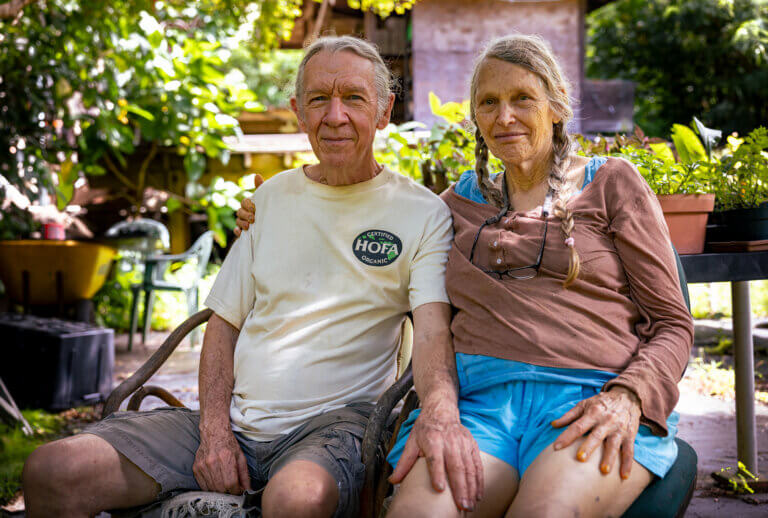
Robin and Dan came to Moloka‘i over 50 years ago. Like everyone else who lives on Moloka‘i, they have direct lineage, which allowed them to move to this island. When they arrived to the homestead, there was nothing on their little remote plot of land, which they could only access by crossing a creek bed.
Dan constructed a series of little wooden footbridges, just wide enough for them to cross to make things easier, but not wide or strong enough for any big equipment. And little by little, Robin and Dan built their life on the island.
They were inspired by permaculture, a way of farming focused on sustainability and culture. They raised goats and planted crops, including avocados, mangoes, bananas, and veggies.
The pair raised four daughters on their farm, all of whom eventually moved away from the island. Now, in their older age, keeping up the farm is more work than it used to be. It wasn’t as easy to bring things across the bridges anymore. Then the storms came.
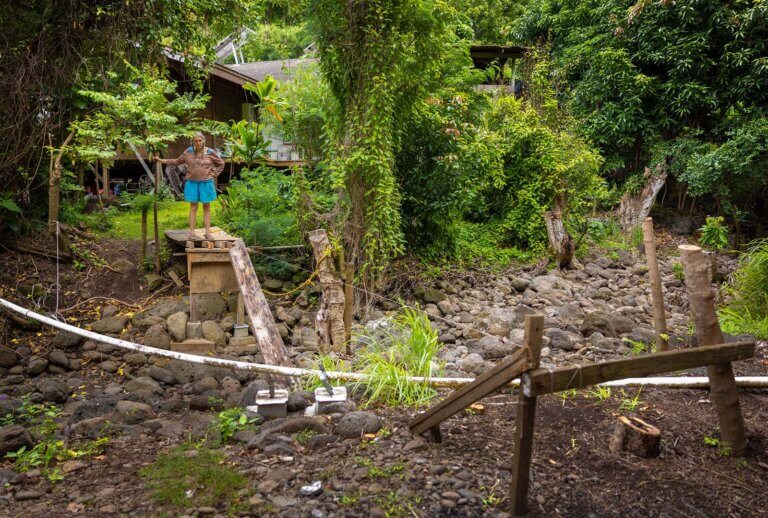
Water flooded through the creek bed, destroying two of the footbridges, leaving Robin and Dan in a really tight spot. Of course, they could still leave their property and carefully walk across the rough, uneven terrain, but it made it nearly impossible to get any farming supplies to their home.
And with no quick access to a large hardware store, rebuilding would not be easy, quick, or cheap. Thankfully, they were put in touch with our response team, who jumped in to lend some assistance.
We were able to acquire some thick PVC piping that will let Dan rebuild the bridges in a way that better equips them to handle future flooding. As farmers, Robin and Dan provide the island with a much-needed source of food. Anything we can do to help get back on their feet benefits the entire island.
As farmers, they’ve certainly felt the love; Robin shared, “After this storm, the amount of feedback that we have gotten as farmers: ‘What you are doing is important. Thank you so much for your food. What can we do to help? You know, you guys deserve the help’… It makes it feel really good to be here on Moloka‘i.”
Meet Micah
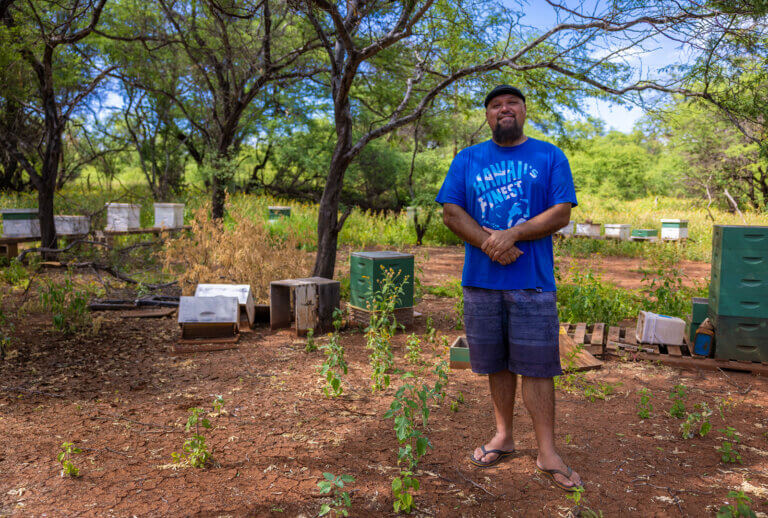
Owning a small business is hard anywhere; being on Moloka‘i takes things to an entirely different level. For a decade, Micah has run a honey business on land that his grandfather used to grow crops on. And it’s been successful; his locally grown honey has won several awards and is prized for its incredible taste, which Micah chalks up to all the Kiawe trees on his land.
He has dozens of bee boxes, each housing its own colony that sends worker bees to gather pollen from the Kiawe trees lining his property. He produces everything right there on his land, harvesting the honey from the bee boxes and taking it to the small building, where he processes it before bottling and selling it to those on the island.
It’s never been easy, but things worked. But this year, as harvesting season neared, these storms came through and disrupted everything. Several of the bee boxes were damaged or fell over into the mud, and the colonies fled and haven’t returned.
Worse still, the roof of the building where Micah houses his production equipment began leaking. As Micah puts it, all of this damage has put him behind.
“Now, instead of just in production mode with, like, harvesting, now we’re in rebuild mode. So now we got to rebuild everything, then get into production, which is very seasonal. So now we’re behind on the season,” Micah said.
And as a small business owner, Micah knows it’s all on him to get things back up and running.
Understanding this big financial burden, CORE stepped in to lend a hand. We provided Micah with funding to help rebuild his damaged bee boxes and to fix his production facility’s roof.
Now, he can get back on track without worrying about those extra funds and falling too far behind.
“In a rural community, it’s hard to be an entrepreneur. In a community where you know we all support each other, but we all need support,” Micah said. “We all support each other, but yet we all need support at the same time, you know? So, when an outside entity comes in and offers help, it is very appreciated, Mahalo.”
If you would like to continue supporting our relief efforts, please consider donating to our emergency response fund, which allows us to mobilize to emerging crises across the globe.